 Aliah Najmabadi, ACTA
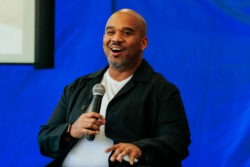
2024 Living Cultures grantee Maurice Wilkins, founder of The Stew, catered the event and shared his journey and heritage within African American and Caribbean traditional foods, along with the stories behind the dishes he prepared for the event. Wilkins emphasized food’s power as a unifier-connecting people through cultural storytelling and celebrations of diverse communities. Wilkins is a community builder who uses food to foster inclusivity and cultural understanding and has been collecting oral histories from Black elders who nourished movements in Oakland and Los Angeles during the 1960s, 1970s, and 1980s as a part of his Living Cultures project.
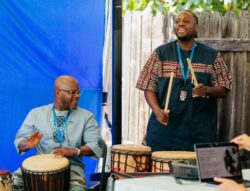
2024 Apprenticeship mentor artist Madiou Diouf who worked with apprentice Ababacar Kouyate in Senegalese drumming, shared the traditional Senegalese rhythms with fellow Diamano Coura musician Eric Gore. Madiou also highlighted the needs of his community as an ACTA 2024 Living Cultures grantee, in his role as Musical Director for Diamano Coura’s 50th Collage des Cultures Africaines. The son of the late Dr. Zakariya Diouf (1938-2021, Senegal) and Naomi Gedo Diouf (Liberia) who still teaches in Oakland, Madiou carries forward the legacy of Diamano Coura—one of Oakland’s most prominent West African dance companies and cultural organizations. Their name, Diamano Coura, means “those who bring the message” in Wolof, a language spoken in Senegal.
The art sharing part of the event closed with 2024 Apprenticeship Mentor artist Julia Cepeda and her apprentice Ansarys Andino, who each danced accompanied by ensemble members of Batey Tambo. Julia Caridad Cepeda Martinez—born into the esteemed Familia Cepeda, a family that has carried the Bomba tradition of Puerto Rico for more than eight generations—continues her family’s legacy in the San Francisco Bay Area, alongside Denise Solís with their community class, Taller Bombalele.
Guided by ACTA Associate Program Director Betty Marín, each of these art shares opened into reflections by the traditional artists, inviting participants to share what sustains them, what challenges they face, and how their practices are evolving in the current moment.
Community Discussion
ACTA invited participants into a communal dialogue around key questions:
How are you holding your communities through this moment? What sustains you in your practice? What collective actions and resources can strengthen our shared cultural future?
In small groups, community members reflected on the urgent conditions shaping their cultural work—from displacement and gentrification to the lasting impacts of redlining and the widespread cuts in arts funding, participants identified key issues facing Bay Area artists and reconvened to share collective insights with the larger group. Culture bearers spoke candidly about the exhaustion that comes with continually fighting for access to spaces, instruments, to keep cultural programs going, especially within immigrant and diasporic communities and the need for mental health support to sustain their practices.
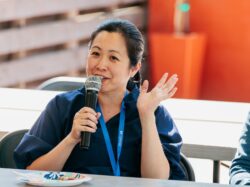
The breakout group discussions surfaced deep concerns about cultural fragmentation, loss of traditions, and the vulnerability of culture bearers. Participants spoke of how political division, generational gaps, and assimilation pressures have weakened cultural continuity and communal ties. Limited funding, lack of dedicated spaces, and fear tied to immigration enforcement further isolate communities and inhibit cultural practice. Many reflected on how traditional and community-based arts continue to be undervalued within Western frameworks, leaving artists under-resourced despite their essential role in preserving and transmitting heritage. Across all conversations, there was a shared understanding that without intentional investment in spaces, resources, and relationships, future generations risk losing connection to their cultural roots.
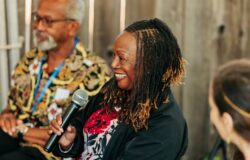
In response, the community emphasized unity, collective action, and intergenerational exchange as vital strategies for revitalization. Building grassroots funding models, deepening collaboration across diverse cultural groups, and centering both youth and elders emerged as shared priorities. Participants called for a shift from entertainment-driven programming toward culturally grounded social action, viewing traditional arts as tools for healing, empowerment, and resistance. Through shared learning, mutual support, and redefined measures of success that value sustainability, belonging, and self-determination, participants envisioned a future rooted in cultural pride, solidarity, and resilience.

As the day came to a close, conversations continued around the tables as participants shared food, exchanged contact information, and reflected on the ideas and connections sparked throughout the gathering. The convening offered a moment to pause, listen, and learn from one another—reinforcing a shared commitment to sustaining traditional arts and community-based practice in the San Francisco Bay Area.
ACTA’s Traditional Arts Roundtable Series continues this ongoing process of listening, learning, and building advocacy for the traditional arts field across California. By convening artists in different regions throughout the state, ACTA collects insight directly from folk & traditional artists, ensuring its programs, grants, and advocacy remain grounded in artists’ lived realities. Through this work, ACTA continues to strengthen collective agency and cultural resilience among traditional artists, advancing a shared movement for cultural sustainability across the state.